
Episode3
Al-Rasheed Street in September
Filming Location: Al-Rasheed Street (Gaza City coastal road)
| Theatrical Version (67min) |
|---|
Story
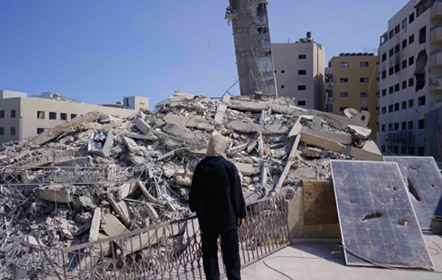
Nearly two years of repeated airstrikes have reduced Gaza to a landscape of rubble as far as the eye can see — a scene that evokes the aftermath of the atomic bombing of Hiroshima.
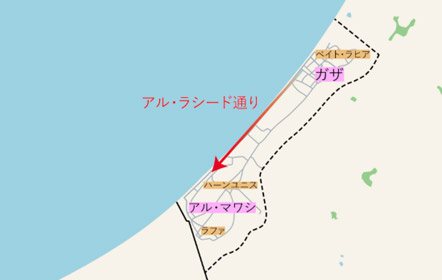
On September 9, 2025, the Israeli military used social media and leaflets dropped from the air to order all residents of Gaza City to evacuate southward to Al-Mawasi via Al-Rasheed Street.
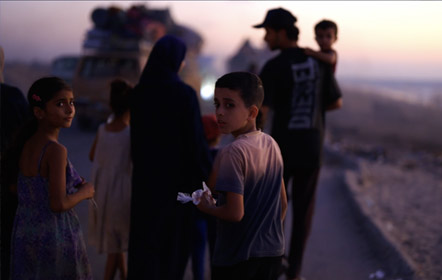
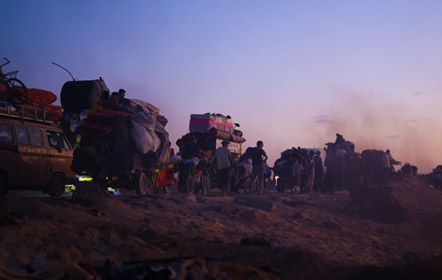
On September 14, the military intensified its operation and issued renewed warnings to civilians who had remained. People began to move en masse — cars, trucks, and horse-drawn carts piled high with belongings, and countless others fleeing with only the clothes on their backs.
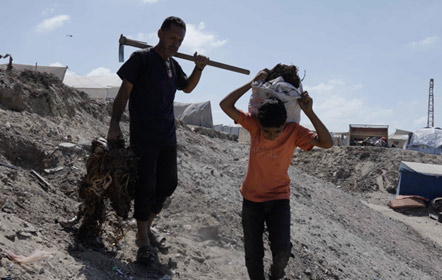
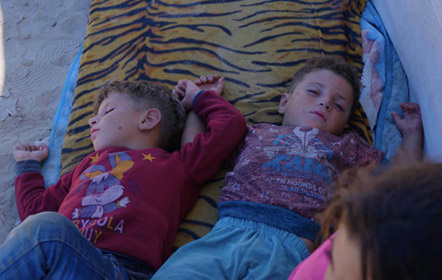
Along the dusty roadside, crowded with displaced people, families worked to set up tents for rest. The faces of children helping their fathers showed deep exhaustion.
Once the tent is up, the family finally sits down to eat. Even amid the destruction, even without a home, life goes on.
On September 16, the anticipated Israeli ground operation began, and fighting in northern Gaza intensified further. That day, thousands of displaced people made their way south along Al-Rasheed Street.
Children evacuating from Gaza City. Four hours, five hours, six hours — they have walked so long they can no longer tell how far they've come.
Tents line the shore of the beautiful Mediterranean. A father collects materials for fuel. A mother bakes bread over an open fire. A girl walks to the sea to fetch water. Some take tea. Some swim. The sun sets and rises again, as it always does.
Displaced but resourceful, the people of Gaza continue to build their daily lives in every way they can.
About Al-Rasheed Street
Al-Rasheed Street is the main coastal road running along the shoreline of Gaza City, in the Gaza Strip, Palestine.
Gaza has been under Israeli blockade since 2005. Power outages lasting up to 20 hours a day are common. Rather than sitting in the dark at home, residents would gather on Al-Rasheed Street at night, where roadside stalls used generators to provide light.
On February 29, 2024, in what became known as the 'Flour Massacre,' crowds of people seeking aid mobbed an incoming delivery truck near a checkpoint. Many were killed or wounded by gunfire and shelling — at least 112 people died and more than 760 were injured.
Repeated Evacuation Orders
One of the defining features of this conflict is that evacuation orders are issued not once, but repeatedly over short periods. As target areas shift constantly, residents are forced to keep moving without any stable place to call home.
The vast majority of Gaza's population has experienced displacement. Nearly everyone has been forced to evacuate at least once, and many have moved multiple times. Even so-called 'safe zones' have been attacked, meaning there is no guarantee that evacuating will lead to safety.
Many people face additional barriers to evacuation: the elderly, people with disabilities, the injured, hospital patients, and medical workers. Repeated displacement has devastated livelihoods and cut off access to food, water, and medicine.
Staff
Director: Mohammed SawwafCinematography: Ibrahim Al-Otla, Hassona Al-Jarjawi
Narration: Ghada Abd Alfattah
Editor: Nobusuke Shiba
Sound: Yusaku Mano
Produced by: UPLINK, ALEF Multimedia